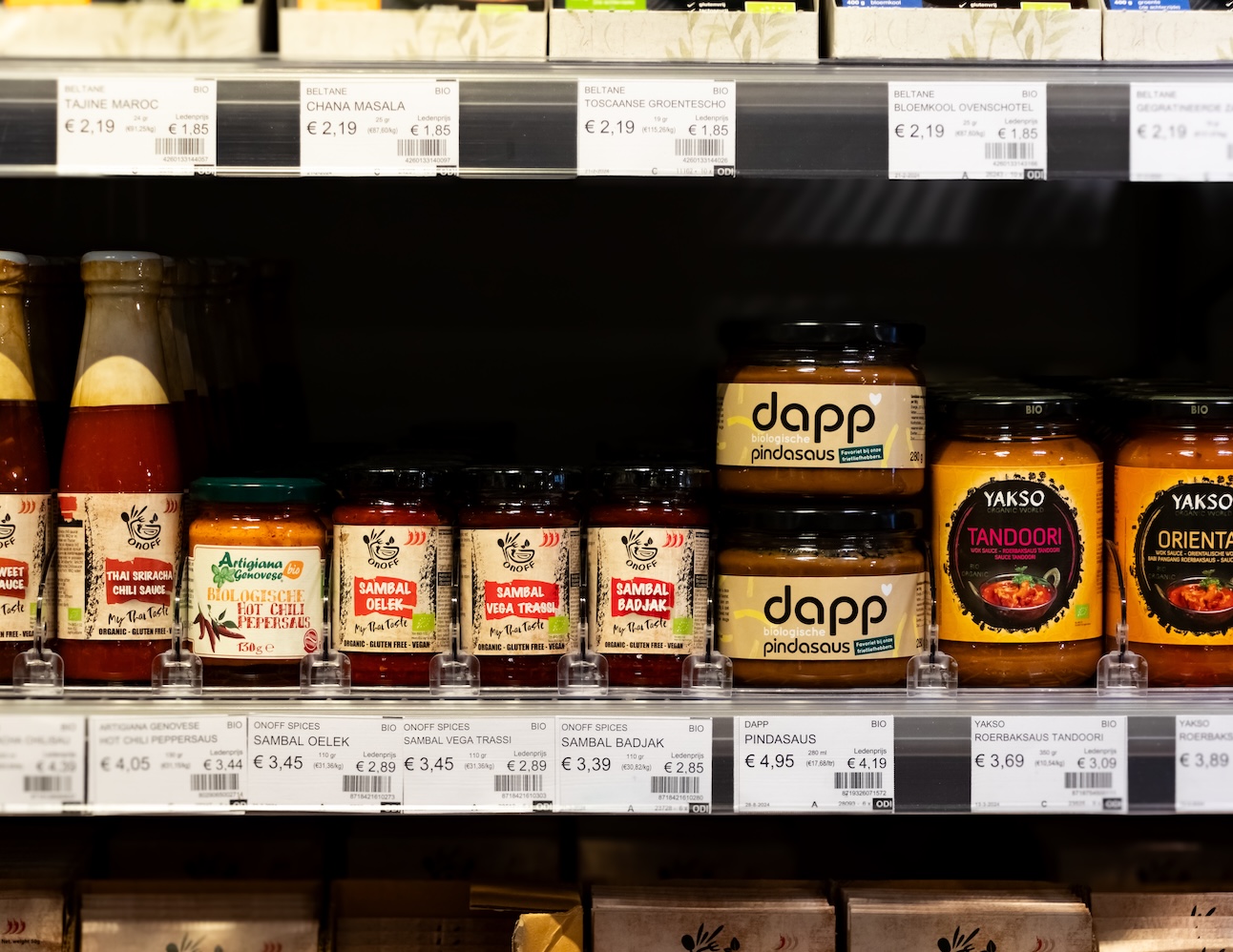
The organic retail market in the Netherlands is growing, but getting a spot on the shelf is no easy feat. Especially when you are starting from zero: no certification, no fixed suppliers, no production line, and no track record with a category manager. It often takes six months of work between the initial idea and the first delivery to an organic wholesaler. Certification, sourcing the right ingredients, flawless labeling, and a compelling brand story each require their own lead time.
Step 1: Certifying the supply chain
In the Netherlands, you cannot sell a product as organic without SKAL Biocontrole certification. This applies to every link in the chain: your raw material supplier, the production facility, the storage warehouse, and the distributor. Wholesalers and supermarkets check this as a standard procedure. No valid SKAL number? The conversation ends there.
Registration takes time. Expect several weeks for administrative processing, followed by an admission assessment and an initial inspection. After that, an annual audit is required. It is not a one-time formality, but a fixed cost that should be in your budget from day one.
What does SKAL certification cost?
- First year: approximately € 2,600 to € 2,900, including registration, admission assessment, fixed fees, and the initial inspection.
- Thereafter: approximately € 1,750 to € 2,030 per year for certification and inspection.
- Small, 100% organic companies with a turnover of less than € 80,000 may be eligible for an exemption from the fixed annual fees. For a startup brand, this makes a significant difference.
Rates are adjusted annually. Check the current amounts and the conditions for exemption on the SKAL website, where you can also read more about certifying every link in the organic chain. Keep up with the latest developments via our news and updates page on organic retail.
The EU organic logo on your packaging is the visible proof that the entire chain is in order. Without that logo, your product has no access to the organic shelf.
Step 2: Sourcing organic raw materials
Organic ingredients are 30 to 100 percent more expensive than conventional versions. The scarcity is often underestimated. Certain organic spices, nuts, or oils are only available from a handful of suppliers, and lead times can sometimes run into months, especially for seasonal crops.
As a new brand, you have no volume and therefore no bargaining power. Growers and importers prioritize their existing customers. You not only need to find a supplier, but also give them a reason to work with you.
Take the example of Royal Spelt. Finding a stable source of organic spelt took months. Only after building a direct relationship with a certified grower could they reliably plan their production. Organic sourcing is a networking skill. You find the right partners through industry contacts and trade fairs, not through a quick search.
Start this earlier than seems logical. The availability of your main raw material determines whether your recipe is feasible. You want to know that before you invest in packaging design.
Step 3: Outsourcing production
For most startups, having your own SKAL-certified production facility is not a realistic starting point. The standard route is to outsource to an organic-certified contract manufacturer. Ensure that organic flows are physically separated from conventional ones at the facility. SKAL verifies this through oversight of organic production.
Discuss minimum order quantities (MOQs), shelf-life guarantees, lead times, and the full cost structure in advance. For a new brand, the MOQ is the pain point: a minimum batch is often far higher than what your initial orders justify, meaning you are pre-financing and carrying inventory risk. Ask about this explicitly and negotiate a smaller trial batch.
Calculate your costs early. If your raw material costs are 60 percent higher, your consumer price must be able to support that, including the wholesaler's margin and the store's margin. A product that becomes too expensive for the shelf has no chance with the category manager.
Step 4: Packaging and GS1 data
This is the phase almost everyone underestimates, and it frequently delays launches. As a new company, you first register with GS1 Netherlands and then generate EAN codes for both the consumer unit and the trade packaging. If your packaging falls under the Single-Use Plastics Directive, SUP regulations also apply. Consult the GS1 codes for packaging and deposits to ensure correct registration.
Your organic label must include your SKAL number, the EU organic logo, the country of origin of the ingredients, and full food information in accordance with the Food Information Regulation. Think of allergens, ingredient lists, net weight, and the best-before date. The NVWA guidelines for food labeling are essential here. A mistake on the label costs weeks, as reprinting and re-approval take time. Therefore, have your design checked before it goes to print.
Step 5: Listing with the organic wholesaler
Listing is all about timing and preparation. Category managers work with fixed review periods: so-called major reviews usually take place semi-annually or annually. If you miss that window, you will wait months for the next opportunity. Shelf plans are set, and space for new products is limited.
This is what you bring to the table:
- A sharp quote with tiered pricing
- Product samples in final packaging
- Clear USPs and positioning relative to competitors
- Professional product photos and commercial copy
- A concrete promotional plan for the first few months
- Logistical terms: lead times, minimum order quantities, returns
The category manager doesn't just evaluate your product; they also assess whether you are a reliable supplier. Can you deliver consistently? Do you respond quickly to questions? An established party has that proof; a new brand does not. Your preparation is your only calling card.
Start small, therefore. Specialty shops and independent organic stores are more likely to take on an unknown brand. Sales figures from those channels are exactly the proof a category manager asks for. Check out our Hanzeroute for organic products to see how we support brands in this process.
Positioning: the story justifies the price
The price of an organic product is defensible, but only if your story and quality live up to it. The consumer in an organic supermarket doesn't just buy a product; they buy a conviction.
A strong brand story rests on four building blocks: supply chain, people, mission, and taste and quality. Who makes it, and where do the ingredients come from? Who is behind the brand, why does this product exist, and what makes it special? The case study of Dapp Sauzen shows how a clear story about local ingredients and artisanal preparation contributes directly to shelf placement. Without that story, you are just the most expensive price tag on a shelf full of familiar names.
From plan to shelf
Introducing an organic product into organic retail is a long-term process. Certification, sourcing, labeling, and listing each require their own expertise and lead time. The brands that successfully end up on the shelf are those that start planning early and don't skip a step.

.jpg)


